
What a pleasure to have support within minutes. Brillant, accurate answer, and solved the question. Thanks to the Formidable Team. Eric


Last updated on August 12, 2026 by Formidable Team
Best WordPress Form Plugins Compared (Free and Paid)
Looking for the best WordPress form plugin? With dozens of builders promising the same thing, the real question is which one still says yes when your project grows past a contact form. In this guide, we compare the best WordPress form plugins, free and paid, so you can pick the right one with confidence.
Approximate read time: 13 minutes
There are a lot of form plugins, and most of them can collect a name and an email. The differences show up the moment you need calculations, payments, repeatable fields, or a way to display what you collect. This roundup puts the most popular options side by side, with links to a full head-to-head for each one so you can go deeper where it matters.
Upgrade your WordPress site with powerful, flexible forms.
How we compared these form plugins
We weighed each plugin on the things that actually separate a great form builder from a frustrating one:
- Free version. Is there a genuinely useful free plugin on WordPress.org, or is the free tier a demo?
- Data ownership. Do submissions live in your WordPress database, or on someone else's servers with per-response limits?
- Room to grow. Calculations, payments, repeater fields, conditional logic, and a way to display submitted data.
- Ease of use. A real drag and drop builder and templates, so you are not starting from a blank screen.
- Pricing. What it costs once you outgrow the free version, including any per-site or per-response caps.
Full disclosure: Formidable Forms is our plugin. We still ranked everything on the same criteria, and we note where a competitor has the edge.
From Idea to Reality in Minutes. Build Powerful Forms, Dashboards, Apps and More.
Formidable Forms makes advanced site building simple. Launch forms, directories, dashboards, and custom WordPress apps faster than ever before.
The best WordPress form plugins
1. Formidable Forms

Formidable Forms is a powerful WordPress form builder for projects that need to do more than collect submissions. It runs in WordPress, saves every entry to your own database, and pairs the drag and drop builder with advanced calculations, native payments, repeater fields, and Formidable Views, which turn form data into directories, listings, tables, and dashboards on the front end of your site.
That last part is the differentiator most builders cannot match out of the box. A form plus a View is a small application, so you can build a quote calculator that feeds a searchable directory and takes a deposit through Stripe, all without leaving WordPress.

- Free version: Formidable Forms Lite on WordPress.org includes the full drag and drop builder, with built-in Stripe and PayPal payments.
- Best for: WordPress users who want one plugin that scales from a contact form to a full web app.
- Pricing: Paid licenses (Basic, Plus, Business, and Elite) start at $39.50 for the first year.

If you are weighing Formidable against a specific tool, the sections below link to a full comparison for each.
2. WPForms

WPForms is a beginner-friendly drag and drop builder with a large template library, which makes it a popular pick for simple contact and signup forms. It deliberately keeps the dashboard simple with minimal options, so new WordPress users can go from install to a published contact form in minutes.
The tradeoff is what the free Lite version leaves out. It does not store submissions in your database, so entries only reach you by email. Lite Connect can back entries up to WPForms' own servers, but you can only view that backup after you upgrade, and fields like a website URL are reserved for paid tiers. The advanced features, like entry storage, integrations, and conversational forms, arrive through higher-priced tiers and add-ons.
- Free version: Yes, with premade templates, reCAPTCHA spam protection, and form import and export, but no entry storage.
- Pricing: Paid plans start at $39.60 for the first year.
- Best for: Beginners who want a guided, template-first setup.
- Compare: See our Formidable Forms vs WPForms comparison, or browse the best WPForms alternatives.
3. Gravity Forms

Gravity Forms is a long-standing developer favorite with strong workflows and a deep add-on ecosystem. It handles payment forms, registration forms, and contact forms well, and developers like its hooks and its mature third-party marketplace.
There are two costs to factor in. First, there is no free version, so you pay before you can test it on a real project. Second, much of what Formidable does natively relies on add-ons here: licenses run $59 to $259, and displaying entries on the front end typically means adding GravityView, regularly $119 a year on its own, which pushes a directory-style build past $350 a year.
- Free version: No. Gravity Forms is a premium plugin only.
- Pricing: $59 to $259 per year before add-ons.
- Best for: Development-heavy teams already invested in its ecosystem.
- Compare: Read the Formidable Forms vs Gravity Forms breakdown, see more Gravity Forms alternatives, or grab a Gravity Forms repeater alternative.
4. Jotform

Jotform is a hosted form builder with a polished interface and one of the largest template galleries anywhere, with more than 10,000 templates and 100+ integrations. There is a WordPress plugin, but it only embeds the hosted form on your page.
Because it is hosted, your submissions live on Jotform's servers under its plan limits rather than in your WordPress database, and the free plan caps how many forms and monthly submissions you get. Costs also scale differently than a WordPress plugin: you pay per month, forever, and going over your submission cap means moving up a tier.
- Free version: Free plan capped at 5 forms and 100 submissions per month.
- Pricing: Paid plans start at $34 per month, billed annually.
- Best for: Teams that want a hosted tool and do not need data on their own site.
- Compare: See our Jotform vs Typeform vs Formidable comparison.
5. Typeform

Typeform is known for conversational, one-question-at-a-time forms with a clean look and smart logic jumps that adapt questions to earlier answers. For a short, well-designed survey, the experience it gives respondents is genuinely hard to beat.
The catch is the meter. Typeform is hosted, shows its branding on lower tiers, and caps responses per month, so a form that takes off can stop collecting until you upgrade. Your data also lives on Typeform's servers, not your site, and the per-month pricing adds up fast compared to an annual WordPress plugin license.
- Free version: Free plan with monthly response limits and Typeform branding.
- Pricing: Paid plans start at $28 per month, billed annually.
- Best for: One-off surveys where presentation matters more than data ownership.
- Compare: Browse the best Typeform alternatives, or see the Jotform vs Typeform vs Formidable comparison.
6. Ninja Forms

Ninja Forms uses a freemium model with a modular add-on approach, so you add capabilities one at a time. The free plugin covers the basics well: a drag and drop builder with side-by-side fields, plus reCAPTCHA and Akismet spam protection. Integrations, though, live on the paid side.
The modularity cuts both ways. Conditional logic, multi-step forms, and payment gateways each arrive as separate paid add-ons, and by the time you have bought several, you may have spent more than one license for a more complete plugin would have cost.
- Free version: Yes, with the drag and drop builder and spam protection; integrations are paid add-ons.
- Pricing: List prices run $99 to $499 per year, with frequent first-year discounts and add-ons also sold individually.
- Best for: Sites that want to bolt on only the pieces they use.
- Compare: See Formidable Forms vs Ninja Forms.
7. Fluent Forms
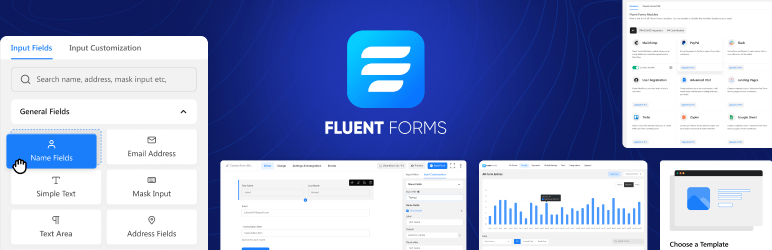
Fluent Forms is a lightweight, performance-focused plugin that loads quickly and covers the essentials well. The free version is one of the more generous ones in this list, and it even includes a limited take on conversational forms, which most builders reserve for paid tiers.
Where it thins out is past the basics. Its data-display and application-building features are more limited than Formidable Views, so it is a better fit for collecting submissions fast than for building anything on top of them.
- Free version: Yes, a generous one, including limited conversational forms.
- Pricing: Paid plans start at $55 per year.
- Best for: Performance-critical sites that prioritize speed.
- Compare: Read Formidable Forms vs Fluent Forms, see the best Fluent Forms alternatives, or the conversational forms alternative to Fluent Forms.
8. Contact Form 7

Contact Form 7 is the original free WordPress form plugin and still powers millions of sites. It is completely free on unlimited sites, and a large ecosystem of third-party add-ons has grown up around it over the years.
The reason most sites outgrow it is the editing experience. There is no drag and drop builder and no live preview, so you assemble forms in markup, and a stray bracket can quietly break the form. There is also no built-in entry storage and no calculations, and support is minimal, so anything beyond a simple contact form means fighting the tool.
What makes the plugin harder to recommend today is that development has effectively frozen. The maintainer has signaled that Contact Form 7 is feature-complete, meaning the gaps in the plugin are not bugs to be fixed but permanent decisions. With development stalled, none of that is likely to change.
- Free version: The whole plugin is free, on as many sites as you want.
- Pricing: Free, with third-party add-ons for extras.
- Best for: A bare-bones, no-frills contact form, if you are comfortable editing markup.
- Compare: See the alternative to Contact Form 7 features comparison.
9. Wufoo

Wufoo is one of the older hosted form builders, with a simple setup and reliable basics. It earned its reputation on being quick to learn, and for a standalone form that lives at a Wufoo link, it still does the job.
Like other hosted tools, it keeps your data on its platform and limits entries by plan, and its pricing has drifted upward over the years: paid plans run $16.25 to $210.25 per month billed annually, which is $195 to $2,523 a year. That is a lot of WordPress plugin licenses for a tool that never touches your database.
- Free version: Free plan capped at 5 forms, 100 entries, and 10 fields.
- Pricing: Paid plans run $16.25 to $210.25 per month, billed annually ($195 to $2,523 per year).
- Best for: Simple hosted forms without a WordPress requirement.
- Compare: See the Formidable Forms vs Wufoo comparison.
10. Google Forms

Google Forms is free and quick for an internal survey or a quick poll, and if your team already lives in Google Workspace, responses land neatly in Sheets with zero setup.
It is just not built for your website. There is no WordPress plugin, embedding means an iframe that ignores your branding, and the data lives in your Google account rather than your site. For anything public-facing, from lead capture to payments, it runs out of road immediately.
- Free version: Entirely free with a Google account.
- Pricing: Free.
- Best for: Fast, free internal surveys.
- Compare: Browse Google Forms alternatives, Google survey alternatives, or Google Forms vs Typeform.
11. Formstack

Formstack is an enterprise-leaning hosted platform where forms are one piece of a larger suite that includes document generation and e-signatures. For teams that need approval workflows across departments, that breadth is the appeal.
For a WordPress site, it is usually more platform than you need. It is priced per month for larger teams, your data stays on Formstack's servers, and the workflow features that justify the cost mostly duplicate what a forms plugin plus your existing tools already do.
- Free version: Trial only; Formstack is a paid platform.
- Pricing: Forms plan from $83 per month, billed annually.
- Best for: Enterprises already using its document and workflow tools.
- Compare: See the best Formstack alternatives.
Building something more specific?
We also compare Formidable against Caldera Forms, Everest Forms, and Jetpack Forms, and for quizzes and interactive content, the best Outgrow alternatives, the Quiz and Survey Master alternative, the WP Quiz Pro alternative, and LeadQuizzes vs Outgrow.
For surveys specifically, see the best SurveyMonkey alternatives.
Quick comparison
| Plugin | Free version | Data lives | Best for |
|---|---|---|---|
| Formidable Forms | Yes, full builder | Your WordPress database | Forms that grow into apps |
| WPForms | Yes, no entry storage | Your WordPress database | Beginners, simple forms |
| Gravity Forms | No | Your WordPress database | Developer workflows |
| Jotform | Yes, hosted limits | Jotform servers | Hosted, non-WordPress |
| Typeform | Yes, response limits | Typeform servers | Conversational surveys |
| Ninja Forms | Yes | Your WordPress database | Modular add-ons |
| Fluent Forms | Yes | Your WordPress database | Speed-focused sites |
| Contact Form 7 | Yes | No built-in storage | Bare-bones contact forms |
| Google Forms | Yes | Google account | Quick internal surveys |
The best form plugin for agencies
If you build sites for clients, the criteria shift. You are weighing per-site costs, white labeling, and how cleanly you can hand a site off without support calls. The plugins that scale best for agencies offer:
- Flexible licensing, with unlimited-site or affordable multi-site options so costs do not balloon per client.
- White labeling, to remove third-party branding from dashboards and notifications.
- Reusable templates and configurations, so you deploy faster on each new build.
- Data display, so client sites can show submissions publicly as directories, listings, or job boards.
Formidable Forms fits full-service agencies well thanks to unlimited site installations on the right license and Formidable Views for displaying data. Gravity Forms suits development-heavy teams, WPForms favors speed with its large template library, Ninja Forms offers per-client modularity, and Fluent Forms is the lightweight pick for performance-critical builds.
How to choose
- Most WordPress sites that will grow: Formidable Forms, because it scales from a contact form to payments, calculations, and Views without a migration.
- A simple form, fast: WPForms or Fluent Forms.
- Just a basic contact form, free: Contact Form 7.
- A hosted tool you will manage outside WordPress: Jotform or Typeform, knowing your data lives off your site.
Which form plugin should you pick?
The best WordPress form plugin is the one that still fits when your project grows. For most WordPress sites, that is Formidable Forms: it starts free, keeps your data on your own site, and scales into payments, calculations, and Views without forcing a migration.
Ready to build forms that do more than collect submissions? Get Formidable Forms and start free today.
Get the Formidable Forms Newsletter
Read more plugin comparisons
 Formidable Forms 7.0: Built for Bigger, Busier Forms
 How to Add a Timer to Your WordPress Quiz
 You Describe the Form, Formidable Builds It in Minutes
Frequently asked questions
What is the best free WordPress form plugin?
Formidable Forms Lite is the best free WordPress form plugin for most sites. It is available on WordPress.org and includes the full drag and drop builder, so you can create and publish working forms at no cost. When you need advanced calculations or Formidable Views, you upgrade to a Business or Elite license without rebuilding anything.
Is Formidable Forms better than Gravity Forms?
For WordPress users who want more than a contact form, yes. Formidable Forms includes Views, repeaters, and advanced calculations natively, where Gravity Forms relies on add-ons for much of that work. Our Formidable Forms vs Gravity Forms breakdown covers the details.
Should I use a hosted form tool or a WordPress plugin?
If your site runs on WordPress, a native plugin is almost always the better choice. You keep your data, avoid per-response limits, and manage everything from one dashboard. If you are leaving a hosted tool, start with the best Typeform alternatives or Google Forms alternatives.
Can a WordPress form plugin handle payments?
Yes. Formidable Forms accepts payments natively through Stripe, PayPal, and Authorize.Net, so you can collect one-time or recurring payments directly from a form without adding a separate shopping cart.
This article may contain affiliate links. Once in a while, we earn commissions from those links. But we only recommend products we like, with or without commissions.