
What a pleasure to have support within minutes. Brillant, accurate answer, and solved the question. Thanks to the Formidable Team. Eric


Last updated on September 13, 2026 by Kyle Cash
How to Create an Elementor Contact Form [For Free!]
Need a contact form on your Elementor page without paying for Elementor Pro? You can add one for free in about five minutes with Formidable Forms' Elementor widget. In this guide, we'll build one together and show you exactly how it stacks up against Elementor's paid version.

Approximate read time: 7 minutes
Upgrade your WordPress site with powerful, flexible forms.
Does Elementor have a contact form builder?
Yes, but only in the paid version. Elementor's Form widget is part of Elementor Pro, which starts at $59 per year for one site on the Essential plan at the time of writing. The free Elementor plugin that most people start with has no form widget at all.
That leaves you with two realistic options:
- Upgrade to Elementor Pro and use its built-in Form widget.
- Install a form plugin like Formidable Forms and drop its widget into your Elementor layout. The core plugin is free, and the contact form you'll build below works entirely on the free version.
Both work. The right pick depends on what your forms need to do, so let's compare them before the tutorial.
From Idea to Reality in Minutes. Build Powerful Forms, Dashboards, Apps and More.
Formidable Forms makes advanced site building simple. Launch forms, directories, dashboards, and custom WordPress apps faster than ever before.
Elementor Pro forms vs. a dedicated form plugin
Elementor Pro's Form widget handles simple lead capture well: name, email, message, maybe a file upload, sent to your inbox or a webhook. For a basic contact page, that's plenty, and it looks great since it lives right inside the page builder.
But the gaps show up fast once a form needs to do more than collect a name and a message. Here's how the two stack up side by side:
| Feature | Elementor Pro Forms | Formidable Forms |
|---|---|---|
| Price for a contact form | From $59/year (Essential license) | Free |
| Works with free Elementor | No | Yes |
| Entry management | Basic submissions log | Full search, filtering, and export (paid licenses) |
| Conditional logic | Needs a third-party add-on | Built in (Basic license and up) |
| Payments | No native payment fields | Stripe, PayPal Commerce, and Square, available on Lite (adds a 3% fee, removed on Business and Elite) |
| Calculators and quizzes | Not available | Built in (Business license and up) |
| Front-end display of entries | Not available | Formidable Views (Plus license and up) |
| Portable if you switch page builders | No, tied to Elementor | Yes, theme and builder independent |
Bottom line: if a contact form is all you'll ever need and you already have Elementor Pro, stick with its Form widget. If you're starting from scratch, or you expect forms to eventually handle payments, registrations, calculations, or quizzes, build on Formidable Forms instead. It's also the safer long-term bet: your forms and entries move with you even if you switch page builders down the road.
How to create an Elementor contact form (step by step)
Here's the full flow using the free Formidable Forms plugin. No Elementor Pro required.
Step 1: Install the free form plugin
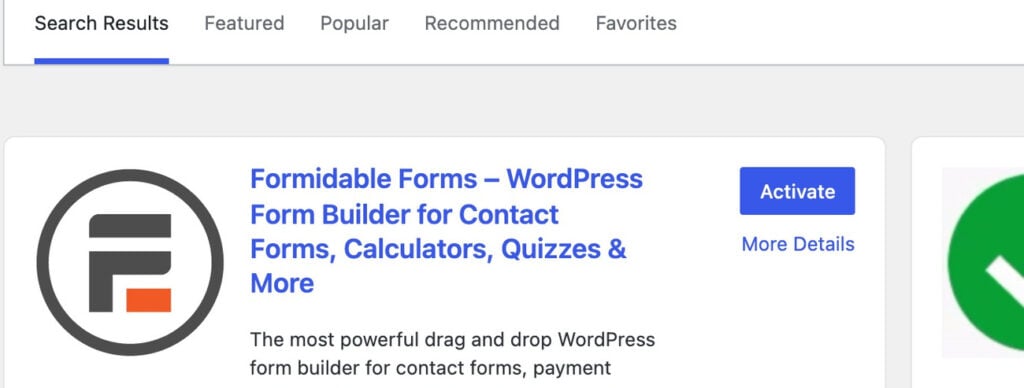
In your WordPress dashboard, go to Plugins → Add New and search for Formidable Forms.
Install and activate the free form builder plugin. That's the only version this tutorial needs, though paid licenses unlock templates, conditional logic, and everything else in the table above.
Step 2: Build your contact form
Go to Formidable → Forms and click Add New.

Choose the Contact Us template for a ready-made starting point, or a blank form if you'd rather build from scratch. Name the form and click Create.
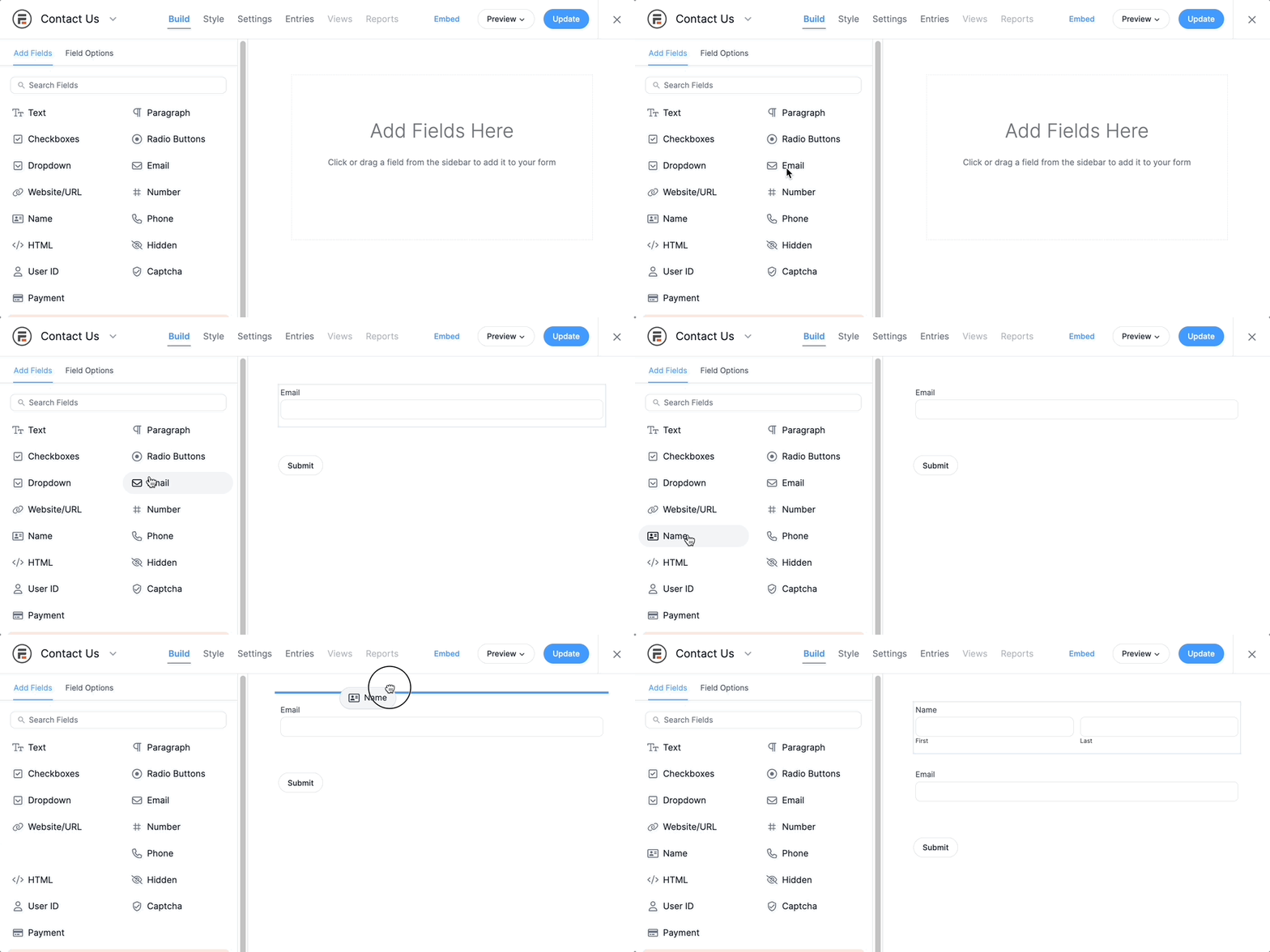
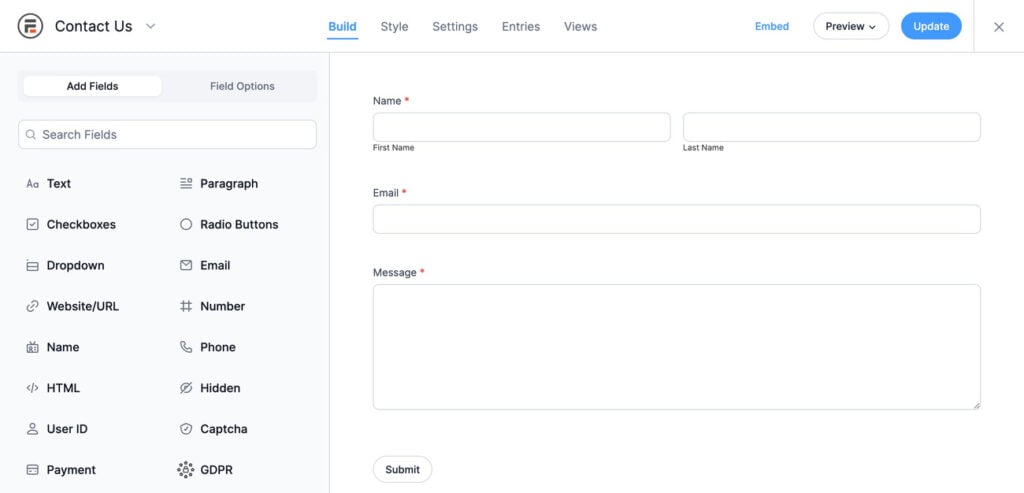
You'll land in the drag and drop builder. A solid contact form only needs three fields:
- Name so you know who's writing
- Email so you can reply
- Paragraph for the message itself
Drag in anything else you need, like a phone field or a dropdown for the subject. Click any field to edit its label and options in the panel on the left. When it looks right, click Update to save.
Before you leave, check Settings → Actions & Notifications to confirm the email notification points to the right address. That's the step people forget, and it's why "my contact form doesn't send emails" is such a common search.
Step 3: Add the form to your Elementor page
Open the page where you want the form and click Edit with Elementor. In the widget panel on the left, search for Formidable Forms and drag the widget into your layout, exactly like you'd place a heading or image widget.
Pick your contact form from the dropdown, and it renders live in the editor immediately. You can toggle the form title and description on or off right in the widget settings.
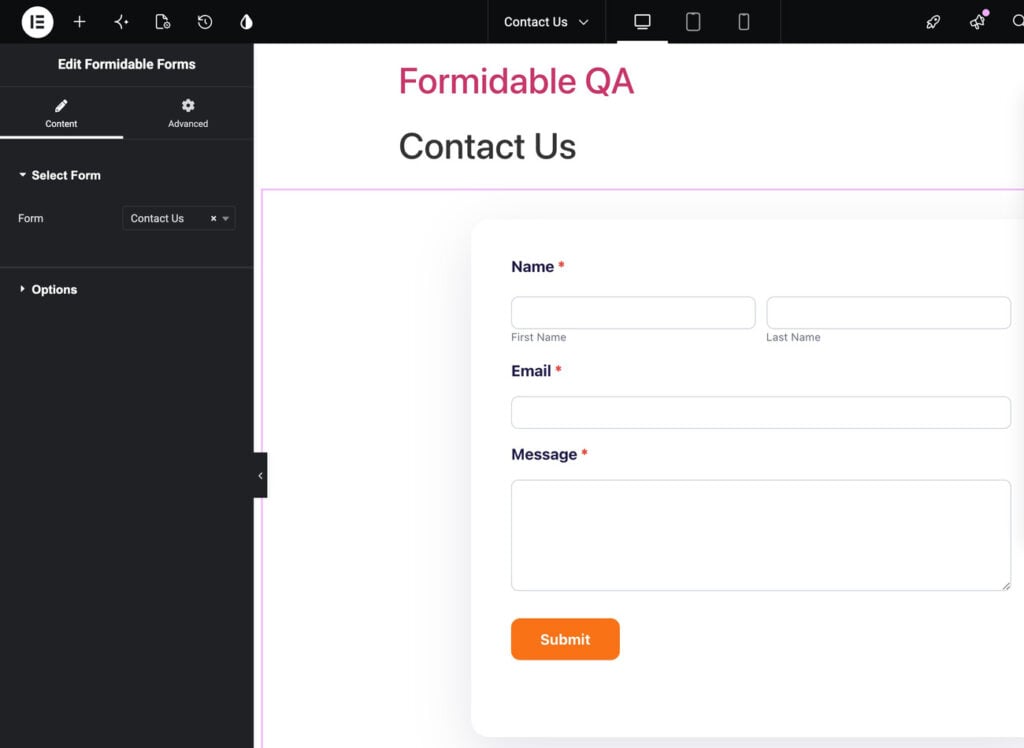
Use Elementor's Advanced tab to control the layout side: margins, padding, column width, and motion effects, the same controls you use on every other widget. Click Update, and your Elementor contact form is live.
Step 4: Style the form to match your design
For the form's own look (field colors, borders, button style, spacing), open Formidable Forms' Visual Styler at Formidable → Styles. Changes preview live, and the style applies across every form on your site, so your contact form, quote form, and newsletter signup all stay consistent.
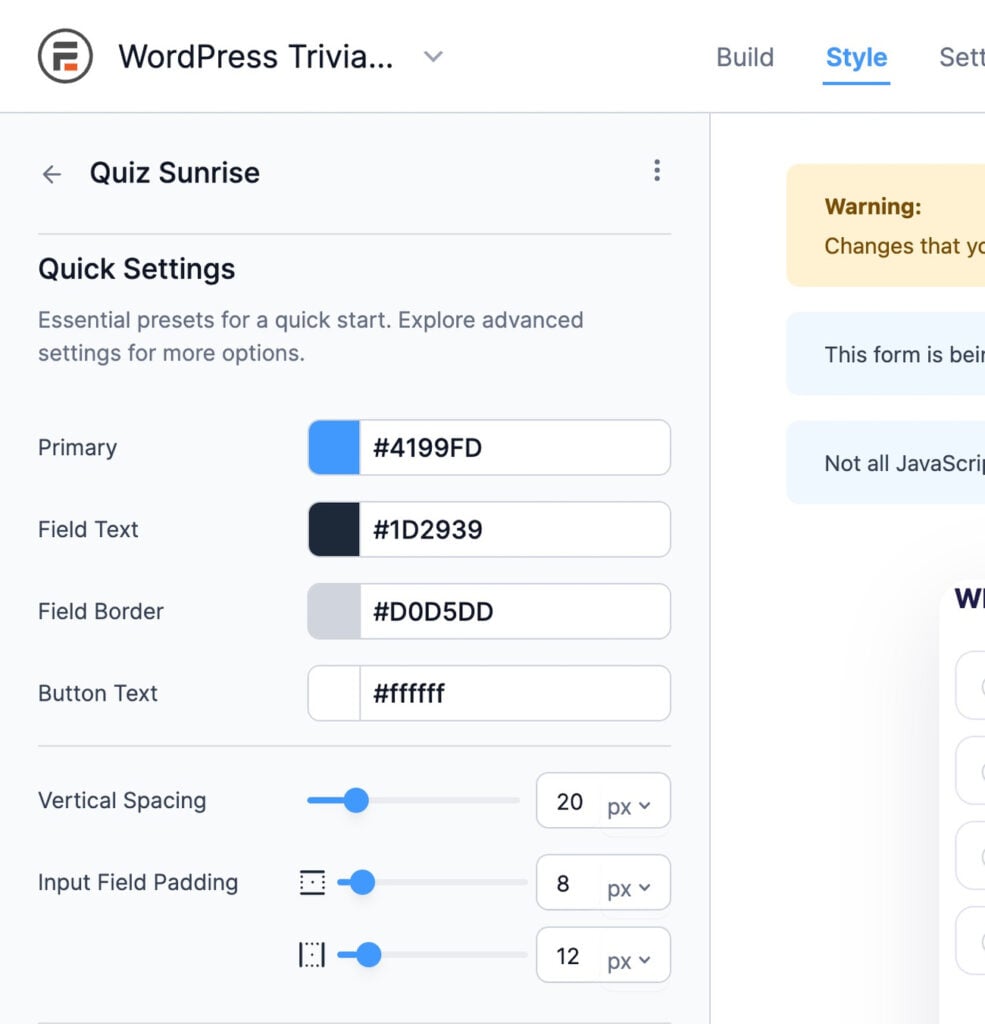
That's the whole build. Submit a test entry to confirm the notification email arrives, and you're done.
The Formidable Forms Elementor widget: what's included
The Formidable Forms Elementor integration is built into the core plugin, so there's nothing extra to install and nothing to pay for. Here's what the widget handles:
- Native widget in the panel. Formidable Forms registers its own Elementor widget, so you drag and drop instead of pasting shortcodes into a text block.
- Live preview while you design. The real form renders inside the Elementor canvas, so you're styling around the actual layout, not a placeholder.
- Every Formidable Forms form type. The same widget places contact forms, quote calculators, registration forms, surveys, and payment forms. Build once, drop anywhere.
- Views work too. On a Plus license and higher, you can display submitted entries with Formidable Views inside your Elementor pages, which is how you build directories and front-end tables on an Elementor site.
Beyond contact forms: Elementor as a full form builder
A contact form is usually just the first form a site needs. Because the widget places any Formidable Forms form, your Elementor site can grow into all of this without a new tool:
- Payment forms. Collect one-time payments through Stripe, PayPal Commerce, or Square on the free Lite plugin. A 3% transaction fee applies on Lite, Basic, and Plus, and it's removed on Business and Elite. Recurring subscriptions start on a Business license, and Authorize.Net and WooCommerce integrations are on an Elite license.
- Smart forms with conditional logic. Show or hide fields based on earlier answers, so a "How can we help?" dropdown reveals only the relevant follow-up questions. Available on every paid license.
- Quizzes and calculators. Scored quizzes, product recommendation quizzes, and price or mortgage calculators are on a Business license, and they embed in Elementor with the same widget.
- User registration and front-end data. Register users from a form (Business license) and display submissions on the front end with Views (Plus license), which turns an Elementor site into a functional web app.
- AI-assisted building through MCP. Connect Claude, ChatGPT, or Cursor straight to your site, and it can build forms, manage entries, and assemble full Views applications from plain-language prompts. Included with the Formidable API Add-on on Business license and up.

That's the practical difference between a form widget and a form builder: the widget puts a box on a page, while the builder keeps solving problems as the site grows.
Ready to add your contact form?
That's everything: install the free plugin, build the form, drag the widget into Elementor, and style it to match your design. No Elementor Pro upgrade required, and no shortcode gymnastics.
When you're ready for more than a contact form, the same setup handles payment forms, quizzes, calculators, and registration forms right inside your Elementor pages.
If a quiz is next on your list, our guide to creating a quiz in WordPress walks through scored and outcome quizzes with the same drag and drop builder. Start with the free plugin and upgrade only when your forms need it.
Can I create a contact form in Elementor for free?
Yes. Elementor's own Form widget requires Elementor Pro, but the free Formidable Forms plugin adds its own widget to the Elementor editor. Build the form in Formidable, drag the widget onto your page, and publish. The whole flow works on free Elementor plus free Formidable.
Does the free version of Elementor include the Form widget?
No. The Form widget is exclusive to Elementor Pro plans, which start at $59 per year for a single site. If you're on free Elementor, you'll need a form plugin to add any kind of form to your pages.
Is Elementor Pro's form builder good enough for my site?
For a simple contact or lead form, yes. It stores submissions and connects to common email tools. It falls short when forms need conditional logic, payments, calculations, quiz scoring, or front-end display of entries, which is where a dedicated form plugin takes over.
Why isn't my Elementor contact form sending emails?
It's almost always a WordPress email delivery problem, not a form problem. WordPress sends mail through PHP by default, which many hosts block or spam filters reject. Check the notification settings on your form first, then set up an SMTP plugin or a transactional email service so messages send through an authenticated mail server.
This article may contain affiliate links. Once in a while, we earn commissions from those links. But we only recommend products we like, with or without commissions.